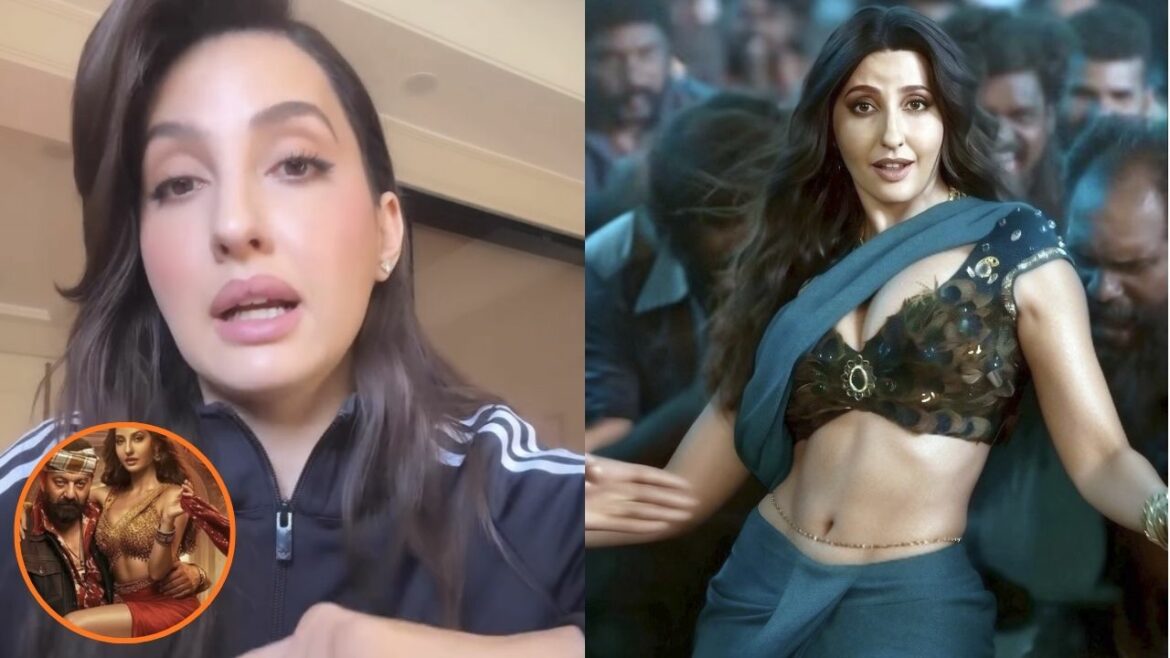
The controversy around ‘Sarke Chunar’ from the film KD: The Devil has become one of the most talked-about entertainment stories. The song faced heavy criticism online because many people found its lyrics and presentation objectionable. As the backlash grew, the issue became serious and the song was eventually taken down.
Now, Nora Fatehi has shared her side of the story. In a public clarification, she said she did not approve the Hindi version that caused the controversy. She also raised concern over the alleged use of AI in the song’s promotional material. Her response has added a new angle to the debate and shifted attention toward the filmmakers and the final editing process.
Why the Song Created So Much Controversy
The issue started when the Hindi version of the song began circulating on the internet. Many viewers reacted strongly and said the lyrics were vulgar and unsuitable. Social media users criticized the song heavily, and soon the matter turned into a major public discussion.
View this post on Instagram
In today’s time, songs can go viral within hours, and public reaction can become intense very quickly. This is exactly what happened here. What may have started as a film promotion soon became a national talking point.
Nora Fatehi Says She Shot the Song Years Ago
One of the most important parts of Nora’s clarification was that the song sequence was actually filmed around three years ago. According to her, it was originally shot in Kannada and not in the Hindi form that later became controversial.
She explained that when she worked on the project, she believed it was being made in a different context. Since she does not speak Kannada, she trusted the team’s explanation during the shoot. This means the version that later created outrage was not necessarily the same version she originally agreed to perform.
Hindi Lyrics Were Allegedly Added Without Her Approval
Nora said the Hindi adaptation of the song was done later and that she was not asked for permission regarding those lyrics. This is the main point of her statement. She made it clear that she was unaware of the final controversial version until it was already public.
This raises an important question about how songs are changed after shooting. In many film projects, content is dubbed, edited, and repackaged for different languages and markets. But when an artist is not informed about those changes, it can create serious misunderstanding and damage their public image.
Her Objection to AI Use in Promotion
Another major point in Nora’s response was her discomfort over the alleged use of AI-generated visuals. She said she was unhappy to see an AI image being used in connection with the song’s promotion.
This issue is bigger than just one film. The entertainment industry is increasingly using AI in posters, promotions, voice work, and editing. But if an actor’s image is recreated or altered without clear approval, it becomes an issue of consent and professional ethics.
In my opinion, this may become one of the most important parts of the controversy. The debate is no longer only about lyrics. It is also about whether technology is being used responsibly in the film industry.
Nora’s Reaction at the Launch Event
Nora also shared that she felt uncomfortable during the launch event of the song. She said she noticed things that she did not like, including visuals and presentation choices that had not been approved by her.
Even though she remained professional in public, she reportedly raised her concerns with the team. This shows that she was not happy with how the final product was being presented. Her statement suggests that performers sometimes have little power when major production decisions are taken by others.
The Pressure Faced by Non-Insider Artists
A striking part of Nora’s statement was her comment about not having strong backing in the industry. She said that artists like her often do not have enough control over how projects are finally released and promoted.
This comment reflects a larger reality in the film world. Big production houses, directors, and studios often control the final version of songs, films, and publicity. The actor may be the face the audience sees, but the real decisions are often taken elsewhere.
That is why this controversy has also become a discussion about fairness. Should the performer alone be blamed, or should the focus also be on the people who created and approved the final content?
Who Should Be Held Responsible
This controversy makes it clear that responsibility in such matters should be shared properly. When a song is written, translated, edited, released, and promoted by a full team, accountability should not fall on only one person.
Audiences often react first to the celebrity in the video because that is the most visible face. But the final output usually passes through many hands, including producers, lyric writers, editors, marketing teams, and film studios.
In news reporting, it is important to look beyond the performer and understand how the final content reached the public.
Impact on KD: The Devil
The controversy has created unwanted attention around KD: The Devil. Instead of discussion focusing on the film itself, much of the attention is now on the song dispute.
This kind of negative publicity can affect audience perception. Even if the film has a strong cast and big production value, controversies of this type can hurt promotion. The makers may now need to rebuild trust and present the project more carefully before release.
A Bigger Lesson for the Film Industry
The ‘Sarke Chunar’ row is a reminder that the entertainment industry must be more careful in the digital age. Lyrics, visuals, translations, and promotional edits can all be examined closely by the public.
This is especially important in multi-language cinema, where one song may be changed and released in different forms. Clear approval from all artists involved should become a basic rule, not an afterthought.
The use of AI also needs stronger boundaries. Technology may help promotion, but it should never replace consent.
Conclusion
The controversy around ‘Sarke Chunar’ is not just about one song getting backlash. It has become a larger story about artistic approval, digital ethics, and accountability in the film industry.
Nora Fatehi’s clarification has changed the discussion by suggesting that the controversial Hindi version was released without her full knowledge or approval. Her objection to the alleged use of AI has also added a serious and modern concern to the issue.
From a broader perspective, this case shows why filmmakers must be transparent and responsible. In today’s fast-moving media world, even one poor decision can damage both an artist’s image and a film’s reputation.
FAQs
What is the ‘Sarke Chunar’ controversy about?
The controversy began after the Hindi version of the song received strong criticism for its lyrics and presentation. Many people found the content inappropriate, leading to public backlash.
What did Nora Fatehi say about the song?
Nora Fatehi said that she did not approve the controversial Hindi version. She explained that she had shot the sequence years ago in Kannada and was unaware of how it would later be changed.
Why did Nora mention AI in her response?
She objected to the alleged use of AI-generated visuals in the promotional material. She said she was uncomfortable with this and does not support such use without approval.
Was the song originally shot in Hindi?
According to Nora, the sequence was originally shot in Kannada around three years ago, and the controversial Hindi version came later.
What larger issue does this controversy highlight?
The controversy highlights concerns about artist consent, final editing control, use of AI in promotions, and who should be held accountable for controversial content.