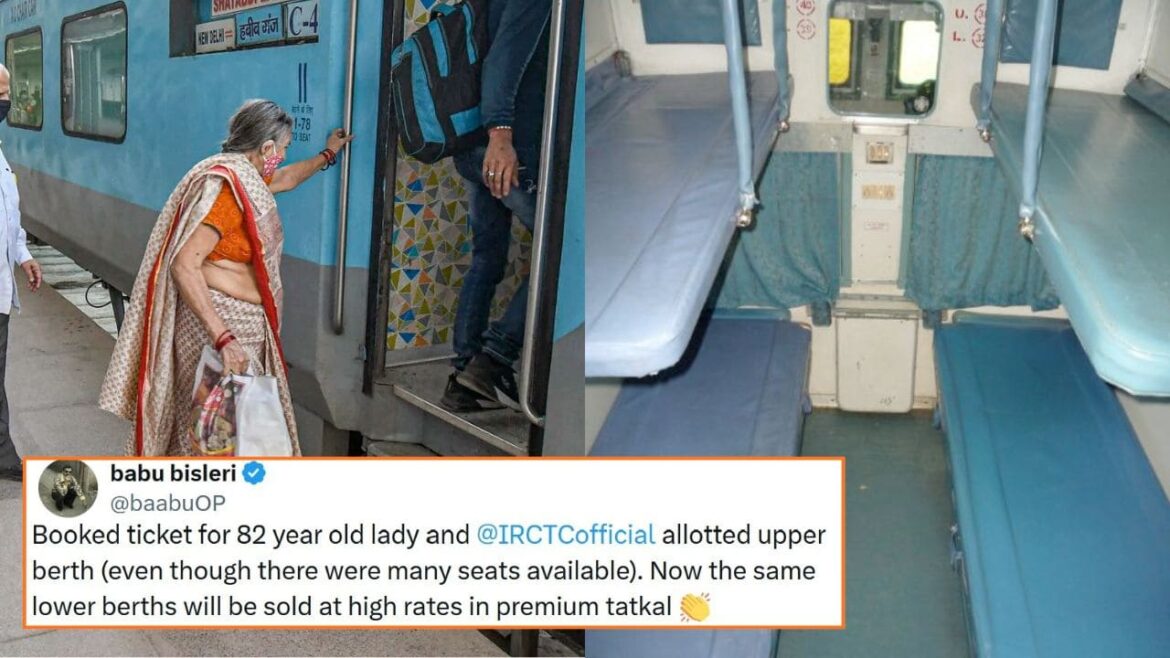
A social media complaint about an elderly woman receiving an upper berth in a train has sparked debate online. The issue raised questions about how seat allocation works in Indian trains, especially for senior citizens.
The matter gained attention after a user claimed that an 82-year-old woman was given an upper berth even though lower berths were available at the time of booking. The post quickly went viral and forced the authorities to respond.
What Was The Complaint About?
The passenger who booked the ticket said he was shocked to see that the elderly woman was assigned an upper berth. According to him, several lower berths were showing as available during booking.
Booked ticket for 82 year old lady and @IRCTCofficial allotted upper berth (even though there were many seats available). Now the same lower berths will be sold at high rates in premium tatkal 👏
Also well done in removing senior citizen quota @AshwiniVaishnaw
— babu bisleri (@baabuOP) February 28, 2026
He also questioned whether lower berths were later sold under premium tatkal at higher prices. The complaint tagged railway authorities and expressed disappointment over the removal of senior citizen concessions in recent years.
This raised concerns about whether the system is truly prioritising elderly passengers.
How The Reservation System Works
The ticket booking system of Indian Railway Catering and Tourism Corporation (IRCTC) is fully computerized. It has a provision to automatically assign lower berths to:
- Senior citizens
- Female passengers above 45 years
However, this benefit depends strictly on availability at the exact time of booking.
If no lower berth is available in the quota meant for such passengers, the system allocates any available berth — including middle or upper.
Passengers also have the option to select “Book only if lower berth is available” while booking online. If this option is chosen, the ticket will not be confirmed unless a lower berth is assigned.
IRCTC’s Official Response
IRCTC clarified that lower berths are allotted automatically to eligible passengers, but only if seats are available when booking is processed.
They also explained that train tickets are sold on a first-come, first-served basis. This means berth preference cannot always be guaranteed.
However, there was no detailed response regarding the premium tatkal pricing concern mentioned in the complaint.
Public Reaction On Social Media
The post received thousands of views and mixed reactions.
Support For The Elderly Passenger
Many users expressed sympathy for the 82-year-old woman. They said elderly passengers should always be given priority for lower berths because climbing to upper berths can be risky and uncomfortable.
Some people shared similar experiences and said they also faced difficulty in getting lower berths for senior family members.
Support For The System
On the other hand, some users defended the railway system. They explained that demand for lower berths is very high, and not every request can be fulfilled.
They also pointed out that trains operate under fixed quotas and algorithm-based allocation.
Understanding The Bigger Picture
Indian Railways carries millions of passengers daily. Managing seat allocation for such a huge number is complex.
Lower berths are limited in each coach. In sleeper class coaches, for example, only a few seats are lower berths compared to total capacity. During peak seasons, competition for these seats becomes intense.
While the system tries to prioritise elderly passengers, practical limitations sometimes lead to such situations.
Need For Better Awareness
Many passengers may not know about the “book only if lower berth available” option. Greater awareness about this feature could help avoid similar complaints.
At the same time, authorities may consider improving transparency in seat allocation to build more trust among passengers.
Conclusion
The controversy around the 82-year-old woman’s upper berth highlights both emotional and technical aspects of train travel. While the computerized system of IRCTC follows fixed rules, real-life situations involving elderly passengers naturally create concern.
This incident reminds passengers to carefully check booking options and also reminds authorities that senior citizen comfort remains an important issue.
Balancing technology, fairness, and humanity is always a challenge in a country where railways are the lifeline for millions.
FAQs
Why was the elderly woman given an upper berth?
IRCTC stated that lower berth allocation depends on availability at the time of booking. If lower berths are not available in the relevant quota, other berths may be assigned.
Does IRCTC automatically give lower berths to senior citizens?
Yes, the system has a provision to automatically allot lower berths to senior citizens and women above 45 years, subject to availability.
Can passengers ensure a lower berth while booking?
Yes, there is an option during online booking to choose “Book only if lower berth is available.” If selected, the ticket will be confirmed only if a lower berth is allotted.
What is premium tatkal?
Premium tatkal is a special ticket booking category where fares increase based on demand. It is mainly used for last-minute travel bookings.
Has IRCTC responded to pricing concerns?
In this case, IRCTC clarified the berth allocation process but did not directly comment on the premium tatkal pricing issue mentioned in the complaint.