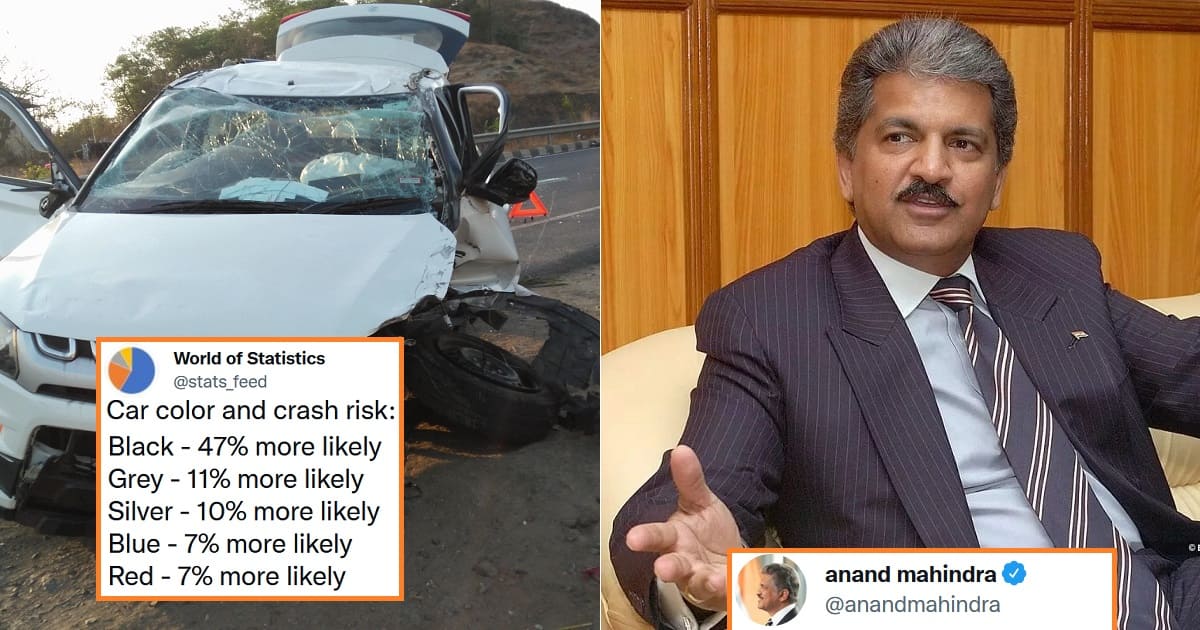
A social media post claiming that black cars are more likely to be involved in accidents recently caught public attention. The statement came from a popular statistics page and quickly started trending online. Soon after, industrialist Anand Mahindra shared his reaction — and his response sparked a fresh debate.
What The Viral Statistics Claimed
According to the viral post, black cars supposedly have a much higher chance of getting into accidents compared to other colours.
The numbers mentioned that darker vehicles are involved in crashes more often than lighter ones like white or yellow cars.
However, the data shared did not clearly explain the source, research method, or background of the study. This made many people question its reliability.
Anand Mahindra’s Witty Response
Anand Mahindra reacted to the claim in a humorous way. Instead of directly attacking the post, he referred to the famous phrase “lies, damned lies, and statistics.”
By using this quote, he indirectly suggested that statistics can sometimes be misleading if shown without proper context.
He also added a simple Hindi phrase that means “anything random,” showing his disbelief in a light and funny tone.
His reply quickly gained attention, with many social media users supporting his view.
Why Colour And Visibility Is Discussed In Road Safety
Some experts say that lighter-coloured cars may be slightly more visible at night compared to darker ones.
For example:
- White and yellow cars reflect more light.
- Black cars may blend into dark surroundings at night.
However, road safety experts also clearly state that the biggest causes of accidents are:
- Overspeeding
- Drunk driving
- Mobile phone usage while driving
- Ignoring traffic rules
- Poor road conditions
Vehicle colour alone cannot be the main reason behind crashes.
Human Error: The Real Cause
In India and globally, studies show that human mistakes are responsible for the majority of accidents.
Distraction, negligence, and risky driving habits play a much bigger role than the colour of the vehicle.
Blaming colour may distract people from focusing on real safety improvements.
Public Reaction On Social Media
After Mahindra’s response, users were divided.
Some agreed with him and said statistics without context can create confusion.
Others argued that visibility studies do exist and darker colours may have a minor disadvantage in certain conditions.
The discussion turned into a larger debate about how data should be presented responsibly.
The Role Of Responsible Statistics
Statistics can be powerful tools. But when numbers are shared without explanation, they can mislead people.
Important questions that should always be asked:
- What was the sample size?
- Was the study conducted officially?
- Were other factors considered?
Without answers to these questions, numbers alone may not tell the full story.
Conclusion
The debate about black cars and accident rates shows how quickly information spreads online. While visibility may play a small role in safety, the biggest factor in accidents remains human behaviour.
Anand Mahindra’s reaction highlighted an important point — statistics should not be blindly accepted without context.
In the end, safe driving habits matter far more than the colour of the car.
FAQs
Did Anand Mahindra deny the statistics completely?
He questioned the credibility of the data and suggested that statistics can be misleading without context.
Are black cars less safe than white cars?
There is no strong universal proof that colour alone makes a car unsafe. Driving behaviour is more important.
What is the main cause of road accidents?
Human error such as overspeeding, distraction, and drunk driving is the main cause.
Why do lighter colours appear safer at night?
Lighter colours reflect more light and may be slightly easier to see in low visibility conditions.
What lesson can we learn from this debate?
Always check the source and background of statistics before believing or sharing them.